Understanding
Case Management
Learn what Case Management is, what we do, and how it helps after a serious motor vehicle crash.
View Questions →
Learn what Case Management is, what we do, and how it helps after a serious motor vehicle crash.
View Questions →Get answers about PIP benefits, coverage, denials, MACP and how Case Management fits into the No-Fault system.
View Questions →Find out how we work, why independence matters, and what to expect when partnering with AICM – Michigan.
View Questions →Information for clients, families, attorneys and providers on how to make a referral and what happens next.
View Questions →A Case Manager helps coordinate the many services that may be needed after a serious motor vehicle crash. Depending on the individual's needs, this can include coordinating physicians, rehabilitation providers, therapists, medical equipment, transportation, home-based services and other resources.
AICM – Michigan also helps identify barriers that may interfere with recovery, communicates with members of the treatment team, follows recommendations and helps keep the rehabilitation plan moving forward.
Case Management may be helpful when an injured person has multiple physicians or therapists, significant injuries, complicated rehabilitation needs, difficulty accessing recommended services, or a family that is struggling to coordinate everything involved in the recovery process.
A referral can be considered early in recovery or later if care becomes fragmented, recommendations are not being implemented, or progress has stalled.
No. A Case Manager coordinates care and services but generally does not provide the hands-on nursing, therapy, attendant care or other treatment being coordinated.
Maintaining that distinction is an important part of independent Case Management. AICM – Michigan works with the providers involved in the client's care while keeping Case Management focused on coordination, communication and the client's rehabilitation needs.
Case Management is primarily a coordination service. The client's physicians, therapists, nurses and other healthcare professionals remain responsible for evaluating and treating the client's medical and rehabilitation needs.
The Case Manager helps those professionals communicate, follows recommendations, helps arrange services and monitors whether identified needs are being addressed.
AICM – Michigan works with individuals recovering from serious motor vehicle crash injuries, including traumatic brain injuries, spinal cord injuries, orthopedic injuries, neurological conditions and other complex injuries requiring coordinated medical and rehabilitation services.
When appropriate and authorized, a Case Manager may attend important medical and rehabilitation appointments to help communicate relevant information, understand recommendations, identify follow-up needs and coordinate the next steps in the client's plan of care.
Talk with an experienced AICM – Michigan Case Manager.
Request a Free Consult →Case Management may be a reimbursable service under Michigan Auto No-Fault when it is reasonably necessary for an injured person's care, recovery or rehabilitation and is related to injuries arising from the motor vehicle crash.
Coverage depends on the facts of the individual claim, applicable PIP coverage and the services being provided.
Medical documentation supporting the need for case management can be important when seeking payment of the service through No-Fault benefits. AICM – Michigan can work with the client's treating professionals to obtain appropriate information regarding the need for case management when necessary.
A denial does not necessarily mean that Case Management is medically unnecessary. The reason for the denial should be reviewed along with the applicable coverage, medical documentation and circumstances of the claim.
When appropriate, AICM – Michigan can provide records describing the Case Management services delivered and the rehabilitation needs being addressed. Questions involving legal rights or disputes with an insurer should be discussed with the injured person's attorney.
The Michigan Assigned Claims Plan provides a process through which certain people injured in motor vehicle crashes may apply for Personal Injury Protection benefits when no applicable No-Fault insurer is otherwise available.
Eligibility depends on the circumstances of the individual claim. AICM – Michigan's Forms & Resources page includes access to the MACP Application for PIP Benefits.
When PIP medical benefits are limited, every service paid from the available benefit can affect how much coverage remains for future medical and rehabilitation needs.
Care coordination becomes especially important in these cases. AICM – Michigan developed FaST Case Management™ as a focused Case Management option for individuals with limited PIP medical benefits.
When sufficient claim and payment information is available, the Case Manager can help identify known services and expenses that may have been paid from a limited PIP medical benefit and help the client and treatment team understand the importance of conserving available resources.
The No-Fault insurer remains the source for confirming the insurer's official accounting of benefits paid and remaining coverage.
Yes. With appropriate authorization, Case Managers may communicate with the No-Fault insurer regarding treatment recommendations, services, authorizations, equipment, transportation and other issues affecting the client's rehabilitation.
AICM – Michigan remains focused on the needs of the injured person while communicating professionally with everyone involved in the claim.

Our team can help explain how Case Management fits within your rehabilitation plan.
Talk With Our Team →Case Managers may be recommended by attorneys, physicians, rehabilitation professionals, insurers, family members or others involved in the recovery process. An injured person can also contact AICM – Michigan directly to discuss Case Management services.
Independent Case Management helps keep the focus on the injured person's needs. The Case Manager can evaluate recommendations, identify resources and coordinate with different providers without the Case Management relationship being tied to a particular treatment provider.
AICM – Michigan's role is to coordinate care, remove barriers and help move the rehabilitation plan forward.
Circumstances vary, but an injured person who has concerns about the Case Management relationship can discuss those concerns with the Case Management agency, attorney, insurer or other appropriate parties.
A productive Case Management relationship should include clear communication, appropriate professional boundaries and a shared understanding of the client's goals and rehabilitation needs.
Yes. Case Management is designed to coordinate the professionals and services already involved in the client's care. AICM – Michigan can communicate with existing physicians, therapists and other providers with the client's authorization.
The Case Manager may help identify appropriate provider options when a new service is needed, but the purpose of independent Case Management is not to force clients into a particular provider network.
The goal is to help the client access qualified, appropriate services that address the identified medical and rehabilitation needs.
The frequency of communication depends on the client's needs and the complexity of the case. Some periods of recovery require frequent coordination, while other periods may require less intensive involvement.
The Case Manager should remain accessible and maintain appropriate communication as needs, appointments, recommendations and barriers arise.
Yes. AICM – Michigan provides Case Management services for individuals throughout Michigan. The appropriate Case Manager and service approach depend on the client's location, needs and circumstances.
Yes. The attorney and Case Manager have different roles. The attorney provides legal representation and advice, while the Case Manager focuses on coordinating medical, rehabilitation and related services.
With appropriate authorization, communication between the attorney and Case Manager can help ensure that important developments affecting the client's care are understood by everyone involved.
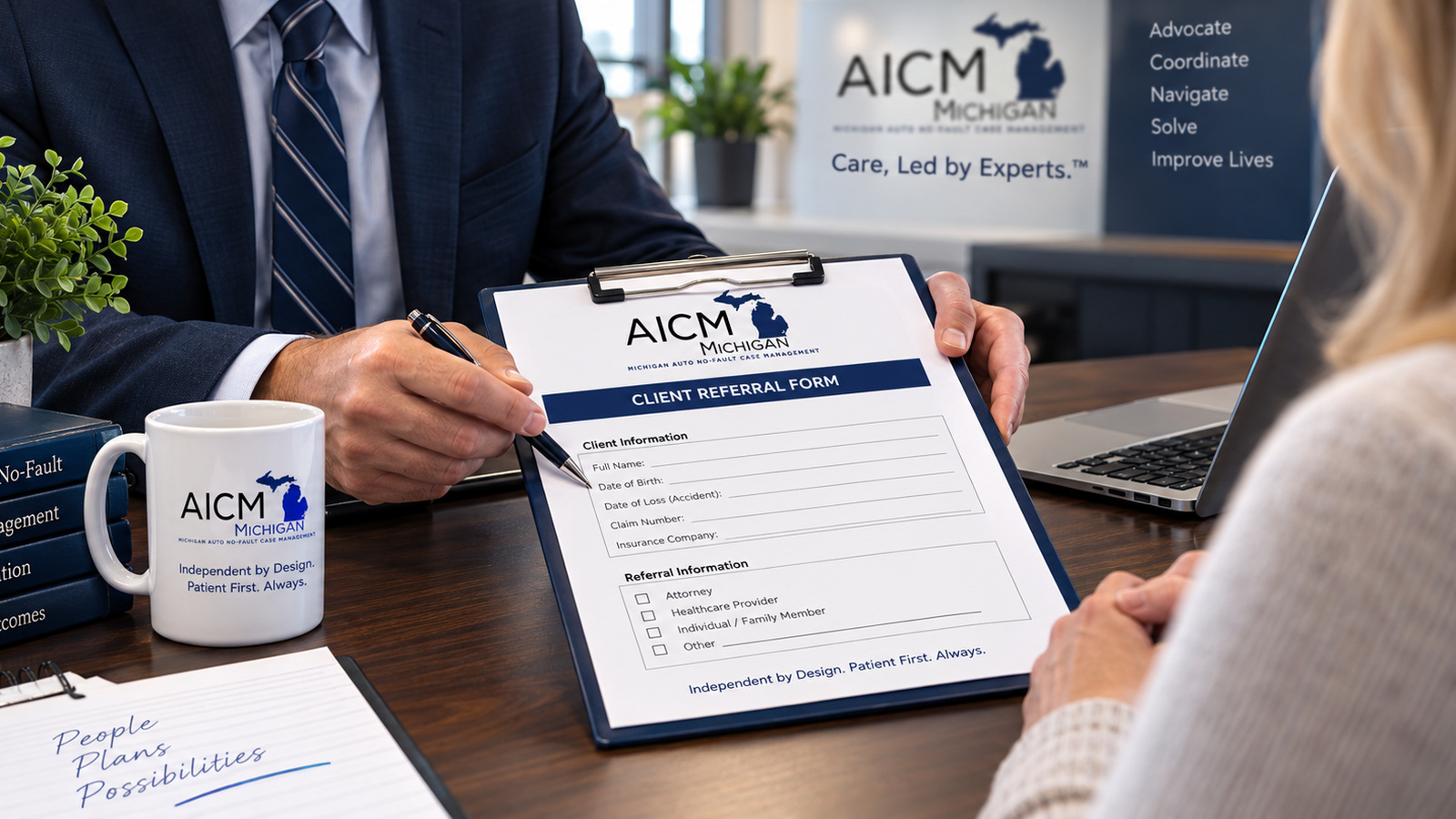
Meet the professionals behind AICM – Michigan's independent Case Management services.
Meet Our Team →Referrals can come from attorneys, physicians, healthcare professionals, rehabilitation providers, injured individuals, family members and others involved in helping coordinate care after a motor vehicle crash.
Yes. Attorneys regularly refer clients to AICM – Michigan when professional Case Management may help coordinate medical and rehabilitation services, address barriers to care or organize a complicated recovery plan.
Yes. Physicians, therapists, rehabilitation professionals and other healthcare providers can refer an injured person when they believe professional case management would help coordinate recommended services and support the rehabilitation plan.
Yes. An injured person or family member can contact AICM – Michigan directly to discuss the situation and determine whether Case Management may be appropriate. A referral does not have to begin with an attorney or healthcare provider.
Helpful information includes the injured person's contact information, date of the motor vehicle crash, No-Fault insurer and claim information, known injuries, treating providers, current services and attorney information when applicable.
You do not need to have every document before contacting AICM – Michigan.
The AICM – Michigan team reviews the referral information, identifies the immediate Case Management needs and determines the appropriate next steps.
This may include speaking with the injured person or family, obtaining authorizations, reviewing available medical information, communicating with the referral source and identifying priorities for the initial case management plan.
AICM – Michigan treats new referrals as a priority. Response time can depend on the information provided and the urgency and complexity of the situation, but our team works to begin communication and referral review promptly.
There is no charge to contact AICM – Michigan to discuss a potential referral and determine whether our case management services may be appropriate.
Call 248.767.7776 or submit a referral through our online referral form.

Use our online referral portal or contact our team directly.
Refer a Client →